In the world of agricultural irrigation, selecting a hose based on a single 'pressure number' is a dangerous gamble. Every year, thousands of dollars are lost to 'blowouts'—not because the product was defective, but because the specifications were misunderstood.
As an irrigation professional, understanding the relationship between Working Pressure and Burst Pressure is the foundation of system safety and longevity.
Working Pressure, often referred to as Operating Pressure or MAWP (Maximum Allowable Working Pressure), is the maximum pressure at which a hose is designed to operate safely under continuous use.
The Standard: This is the 'cruising speed' of your hose.
The Limit: Exceeding this pressure for extended periods leads to material fatigue, stretching, and eventual failure, even if you don't reach the burst point.
Burst Pressure is a laboratory-tested limit. It is the point at which a hose is physically destroyed or ruptured during a pressure test.
The Reality Check: Burst pressure is not an indicator of how much pressure the hose can handle in the field. It is a benchmark used to determine the hose's safety margin.
Industry Warning: Never operate an irrigation system at or near the burst pressure.
The gap between the Working Pressure and the Burst Pressure is known as the Safety Factor. In professional irrigation, the standard ratio is usually 3:1.

Example: If a high-pressure layflat hose has a Burst Pressure of 45 Bar (650 PSI), its Working Pressure should be rated at 15 Bar (217 PSI). This 30-bar buffer exists to protect your farm from "Water Hammer"—sudden pressure surges caused by valves closing or pumps starting.
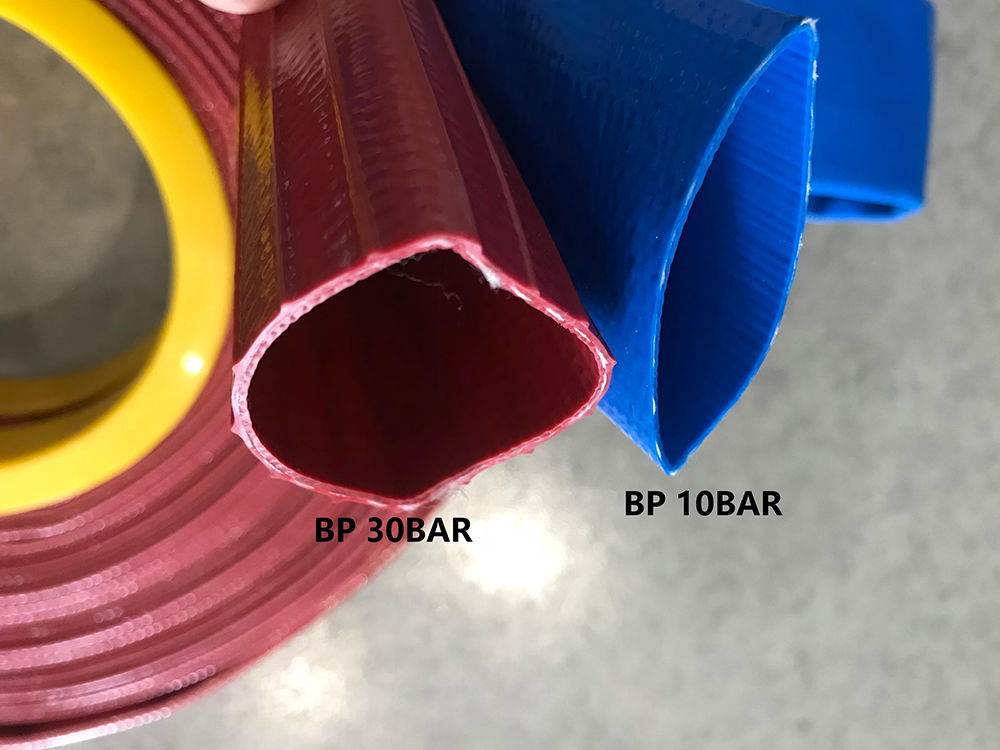
A hose rated for 10 Bar in a catalog may not handle 10 Bar in your field. Why?
Temperature: As the ambient temperature rises, polymer-based hoses (PVC/PE/TPU) soften. A hose used in 40°C (104°F) heat may lose up to 20% of its pressure capacity compared to its rating at 20°C.
Mechanical Wear: Scratches and abrasions act as 'stress concentrators,' significantly lowering the burst threshold.
Chemical Exposure: Certain fertilizers and pesticides can degrade the inner lining, weakening the reinforcement layer over time.
When reviewing a quote from a manufacturer, always ask: 'Is this the Working Pressure or the Burst Pressure?' If a price seems too good to be true, the supplier might be quoting you the Burst Pressure to make the hose seem stronger than it actually is.
 English
 Español
 русский
 العربية