Protect drip irrigation systems from clogging caused by algae, organic matter and suspended solids.
SEAPEAK manufactures sand media filters for agricultural and drip irrigation systems. These filters use a deep media bed to remove suspended solids, algae and organic contaminants from river, reservoir, canal and other surface water sources. Multiple tank configurations and flow capacities are available to match different irrigation projects.
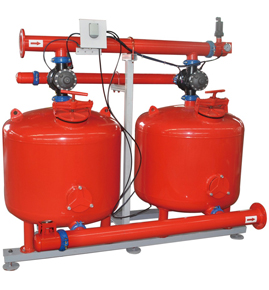
Drip emitters have narrow flow paths that can be blocked by algae, organic matter and suspended solids. Sand media filters use a deep filtration bed to capture contaminants throughout the media layer, making them particularly suitable for surface water with a high organic load. They are commonly used for water drawn from rivers, ponds, canals and reservoirs.
As an ISO 9001-certified manufacturer with exports to the US, Canada, Europe, and Russia, Seapeak delivers filtration solutions you can rely on.
Filtration:Water passes through the filter media bed, where sand, silt, algae, organic matter and other suspended contaminants are trapped. The filtered water then flows into the irrigation system.
Pressure Differential:As contaminants accumulate in the media bed, resistance to water flow increases. This causes the pressure difference between the filter inlet and outlet to gradually rise.
Automatic Backwashing:When the pressure differential reaches the preset value, the system automatically starts the backwash cycle. Water flows in the reverse direction through the media bed, loosening and flushing out the accumulated contaminants.
Return to Filtration:After the backwash cycle is completed, the filter automatically returns to normal filtration operation.
Deep-bed filtration – holds more dirt than screen or disc filters
Automatic backwash – PLC or pressure switch controlled, no manual work
Non-stop irrigation – other tanks keep running during backwash
Low water waste – backwash consumes minimal water
Durable construction – epoxy-coated carbon steel or stainless steel tanks available
Flexible control – manual, PLC, or pressure switch options to fit your system
| Model | Number of Tanks | Minimum Flow Rate (m3/h) | Maximum Flow Rate (m3/h) | Filtration Area (m2) | Backwash Flow Rate (m3/h) | Media Capacity (kg) | Maximum Working Pressure (Mpa) | Inlet Size | Drain Size | Weight (kg) |
| SP16-2 | 2 | 12 | 20 | 0.26 | 10 | 220 | 1 | 3" | 2" | 140 |
| SP24-2 | 2 | 30 | 50 | 0.58 | 20 | 500 | 1 | 3" | 3" | 216 |
| SP30-2 | 2 | 30 | 70 | 0.91 | 35 | 640 | 1 | 4" | 3" | 318 |
| SP36-2 | 2 | 60 | 100 | 1.31 | 45 | 920 | 0.8 | 4" | 3" | 400 |
| SP40-2 | 2 | 90 | 130 | 1.62 | 65 | 1120 | 0.7 | 6" | 4" | 512 |
| SP48-2 | 2 | 100 | 180 | 2.32 | 80 | 1600 | 0.6 | 6" | 4" | 650 |
| SP48-3 | 3 | 150 | 270 | 3.48 | 80 | 2400 | 0.6 | 6" | 4" | 975 |
| SP48-4 | 4 | 200 | 360 | 4.65 | 80 | 3200 | 0.6 | 8" | 4" | 1300 |
| SP48-5 | 5 | 250 | 450 | 5.81 | 80 | 4000 | 0.6 | 8" | 4" | 1760 |
| SP48-6 | 6 | 300 | 540 | 6.97 | 80 | 4800 | 0.6 | 8" | 4" | 1950 |
| SP60-2 | 2 | 160 | 220 | 3.64 | 130 | 2500 | 0.6 | 6" | 4" | 972 |
Specifications are for reference only. Final filter selection should be based on water quality, required flow rate, operating pressure and irrigation system design.
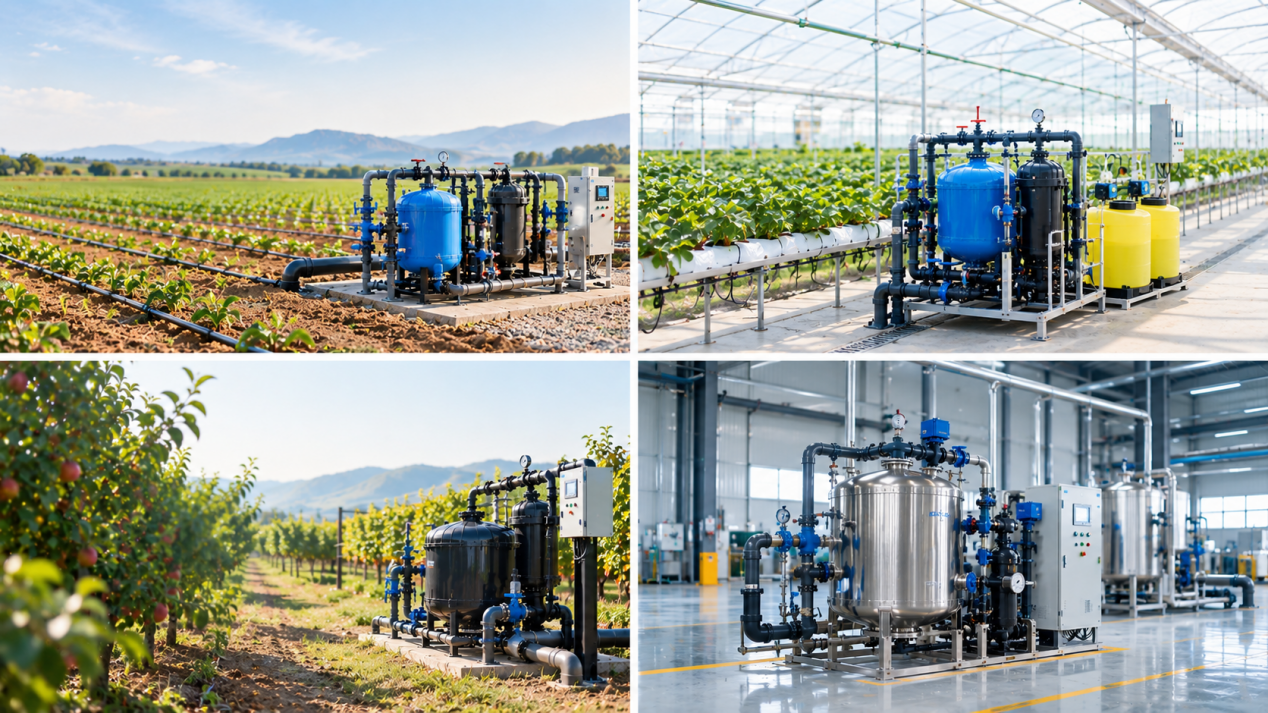
Agricultural drip irrigation
Greenhouse irrigation
Orchard & vineyard irrigation
Industrial water pre-filtration
| Feature | Sand Media Filter | Screen Filter | Disc Filter |
| Filtration Method | Deep media filtration | Screen surface filtration | Grooved disc filtration |
| Best Suited For | Surface water with algae and organic matter | Relatively clean water with inorganic particles | Water containing mixed suspended particles |
| Dirt-Holding Capacity | High | Low to medium | Medium to high |
| Typical Application | Primary filtration for river, pond or canal water | Secondary or final filtration | Primary or secondary irrigation filtration |
| Cleaning Method | Backwashing | Manual cleaning or automatic flushing | Manual cleaning or automatic backwashing |
Actual filtration performance depends on filter rating, water quality, system flow and equipment configuration.
A sand media filter is used to remove suspended solids, algae and organic matter from irrigation water. It is particularly suitable for drip irrigation systems using water from rivers, canals, ponds and reservoirs.
Sand media filters are commonly used for surface water sources such as rivers, lakes, ponds, canals and reservoirs. A water-quality analysis is recommended before selecting the filtration media, flow capacity and tank configuration.
Backwash frequency depends on water quality, flow rate and contaminant load. Backwashing is commonly triggered when the inlet-to-outlet differential pressure reaches the equipment’s specified setting or after a preset operating period.
Graded silica or quartz-based media is commonly used. The appropriate media size and bed depth depend on the required filtration performance and system design.
Filter selection should be based on the design flow rate, water source, contaminant type, operating pressure and allowable pressure loss. Send us your water-quality information and required flow rate for model selection.
Yes. Tank quantity, flow capacity, inlet and outlet sizes, backwash control and system configuration can be selected according to project requirements. Available customization options should be confirmed with SEAPEAK before ordering.

 English
 Español
 русский
 العربية