At the heart of every micro-irrigation system lies the emitter. To understand which one fits your farm, you can refer to different types of drip irrigation drippers, as choosing the right one dictates whether your crops receive uniform nutrients or suffer from localized drought.
To design a high-efficiency drip system, irrigation engineers classify drippers based on their pressure regulation capability and physical structure.
This is the most critical distinction in drip irrigation technology.
Pressure Compensating (PC) Drippers: These emitters feature a built-in silicone diaphragm. As system pressure fluctuates due to long lateral runs or rolling hills, the diaphragm flexes to constrict or open the flow path. This guarantees a constant discharge rate (e.g., exactly 2 L/h) across a wide pressure range (usually 0.5 to 4.0 Bar).
Non-Pressure Compensating (Non-PC) Drippers: The flow rate depends directly on the water pressure. The higher the pressure (or the lower the elevation), the more water discharges. These are reserved for perfectly flat terrains and short run lengths.
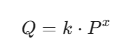
Where Q is the flow rate, P is pressure, k is a discharge constant, and x is the flow exponent. For a perfect PC dripper, x = 0 (flow is independent of pressure); for Non-PC drippers, x ≈0.5.
Depending on your installation preferences and crop types, drippers come in three primary formats:
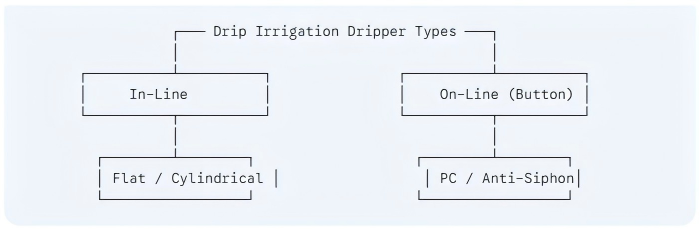
In-Line Emitters (Flat or Cylindrical): Welded into the inner wall of the irrigation pipe hose during factory extrusion. Ideal for row crops (e.g., corn, berries). Cylindrical emitters offer larger filtration areas, while flat emitters reduce hydraulic friction inside the pipe.
On-Line Emitters (Button Drippers): Punched into the exterior of the pipe manually. Best for orchards, vineyards, and landscaping where plant spacing is irregular.
When sourcing drippers, look for models featuring a Turbulent Flow Labyrinth Path. By forcing water through a sharp, winding maze, it creates high turbulence that continuously flushes out suspended solids, preventing bio-clogging. For subsurface drip irrigation (SDI), ensure the drippers have Anti-Siphon (AS) mechanisms to prevent soil suction when the system is turned off.
Connecting your emitters to an optimized layflat main supply line setup ensures uniform pressure and prevents clogging across long crop rows.
 English
 Español
 русский
 العربية