When designing an efficient drip irrigation system, one of the most important decisions is choosing between online drippers and inline drip tape or drip line.
Both systems deliver water with incredible precision, but they are designed for entirely different planting patterns, crop types, and scales of operation. Let's compare them head-to-head to help you choose the most cost-effective solution for your farm or commercial project.
Online drippers are individual emitters—including button drippers, take-apart PC drippers and arrow drippers—that are installed at selected positions along PE lateral tubing.
Inline drip tape or drip line contains pre-installed emitters at specified spacing intervals, making it suitable for evenly spaced crop rows.
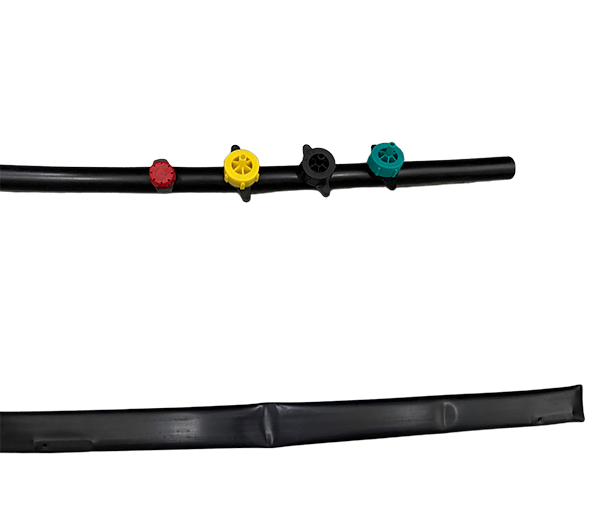
Using the wrong system can dramatically increase labor costs or result in inefficient water coverage. Here is how they stack up across key factors:
Comparison Metric | Online Drippers (Button/Punch-In) | Inline Drip Tape / Drip Line |
Planting Arrangement | Irregular spacing, scattered plants | Straight, evenly-spaced crop rows |
Installation Labor | High (each dripper must be hand-punched) | Extremely Low (just roll it out) |
Durability & Lifespan | 5 to 10+ years (thick-walled PE tubing) | 1 to 3 seasons (typically thin-walled tape) |
Ideal Crop Types | Orchards, vineyards, shrubs, potted plants | Vegetables (tomatoes, strawberries, potatoes) |
Initial Material Cost | Higher per foot | Extremely economical for large fields |
You are growing trees, vines, or shrubs that are spaced far apart or irregularly.
You want a heavy-duty, long-term system that will stay in the ground for many years.
You have potted plants, greenhouses, or landscaping with varying water requirements per plant.
You are growing row crops with tight, uniform spacing (like onions, garlic, leafy greens, or berries).
You are irrigating large agricultural acreage where manual hole-punching is labor-prohibitive.
You practice seasonal crop rotation where the irrigation lines need to be easily rolled up and replaced each year.
Regardless of which option you choose, suitable filtration and regular flushing are important. Learn how to prevent clogged drip emitters and maintain consistent water delivery.
 English
 Español
 русский
 العربية